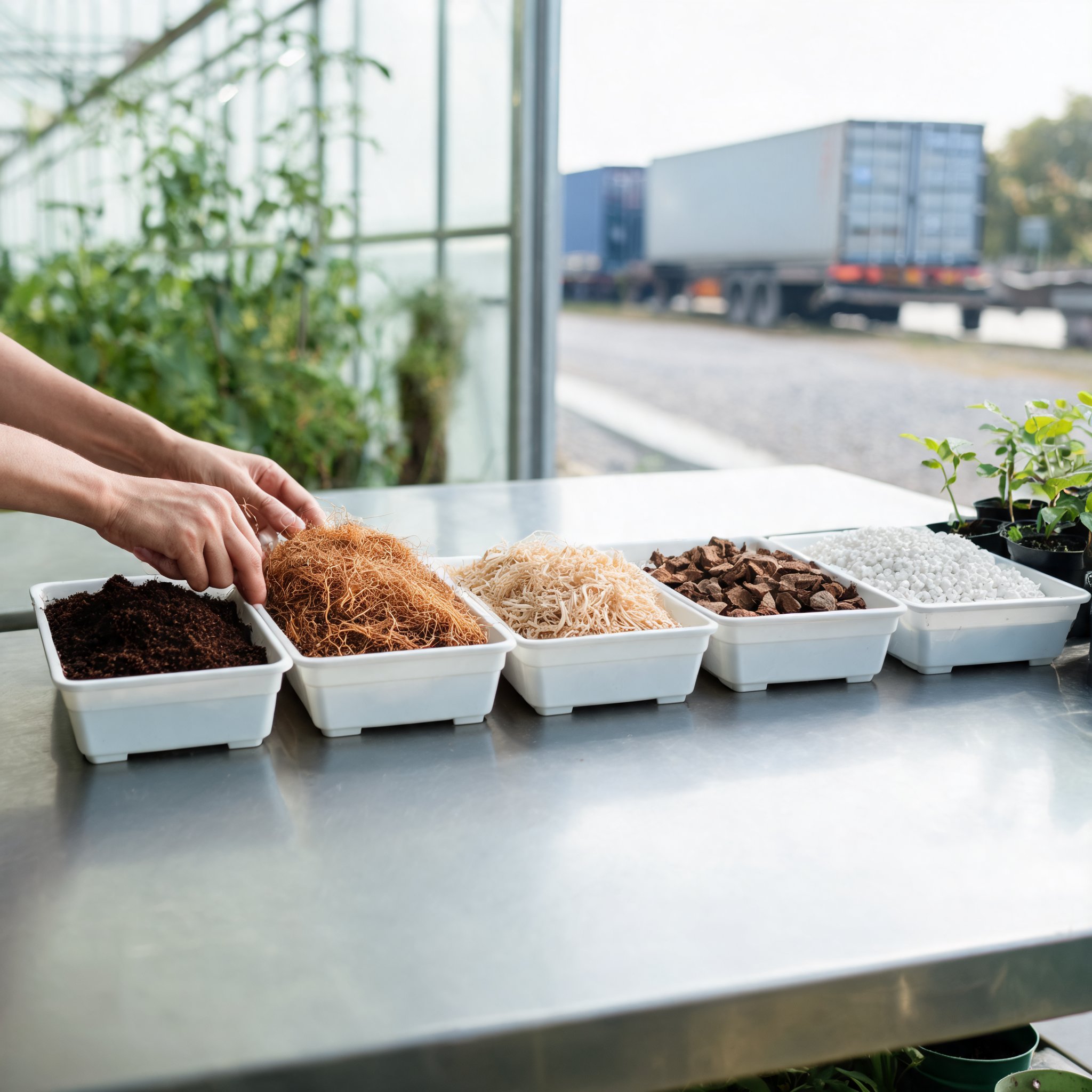
Canada's latest peat extraction figures are a supply-chain signal, not a shortage alarm. The Canadian Sphagnum Peat Moss Association's Sept. 17 report, covering conditions through Aug. 31, shows wide regional variation in how much peat producers extracted against their own seasonal targets.
What the harvest numbers actually show
Alberta reached 56% of expected extraction, Manitoba 79%, Saskatchewan 90%, Québec's North and South Shores 77%, Southern New Brunswick 70%, Northern New Brunswick 85%, and Ontario 90%. Prince Edward Island, Newfoundland and Labrador, and Nova Scotia were reported as significantly below expected levels.
CSPMA attributes much of the shortfall to wet weather. Just as importantly, the association says careful inventory management should allow producers to meet customer needs — a meaningful distinction, because the report is not a declaration of peat shortage.
Nor is "expected extraction" a measure of how much available peatland was harvested. As CSPMA defines it, the figure is the volume producers calculated they needed for the season: market requirements plus the desired year-end inventory buffer, minus inventory carried into 2026. It is a planning target, not a physical ceiling.
Peat is one variable in a wider cost picture
Peat is only part of the supply equation. Climate affects harvest and biomass availability. Labor affects harvesting, processing and transportation. Freight can change the economics of a material well before its FOB price moves.
Transportation is especially volatile right now. The Wall Street Journal reported in late September that U.S. contract trucking rates averaged $3.11 per mile in August, including fuel surcharges, up 29% from a year earlier. Diesel costs, driver availability, rail surcharges and ocean freight are all adding volatility. For a bulky input such as growing media, delivered cost can change the answer to a sourcing decision very quickly.
Dr. Charlie Hall has made a similar point from the broader grower-cost perspective. In a recent Greenhouse Grower interview, Hall emphasized supply-chain agility, backup suppliers and working-capital discipline as growers plan for 2027. His Index of Prices Paid by Growers is useful precisely because the cheapest input on paper is not necessarily the lowest-risk or lowest-cost decision once freight, inventory and operational impacts are included.
The practical implication is that raw-material selection is no longer just an annual purchasing exercise. It is becoming a risk-management and production-design decision.
Design from the crop backwards
Growing media is often built in the opposite direction from how it arguably should be. The common approach starts with what is available — peat, coir, bark, wood fiber, perlite or another familiar component — and then constructs a mix around those ingredients.
A better starting point is the crop itself. What character does the root zone need? How much water holding, and how much air porosity? What structural stability is required across the crop cycle? How does the material need to rewet? What buffering and chemistry can the crop and irrigation program tolerate? How uniform does it need to be for automation? Once those requirements are clear, the ingredients and percentages can be chosen to create that character.
This matters because the raw-material toolbox is expanding. Wageningen University & Research's 2026 work on the future of growing media identifies familiar market-accepted materials such as coir, coniferous wood fiber, bark, compost and perlite, but also less familiar candidates including other plant fibers, biochars, co-composts and reused growing media. The researchers stress that many new materials require processing, sanitization and stabilization before they can become reliable horticultural inputs. Availability, in short, is not the same as suitability — but suitability is increasingly something that can be engineered.
Why older material options deserve a second look
Processing technology has continued to improve across coir, wood fiber, bark and other biomass streams. Materials that were too inconsistent, too wet, too coarse, too salty, too difficult to handle or simply too expensive a few years ago may deserve another look. The same applies to regional agricultural residues that can be cleaned, screened, fiberized, composted or otherwise stabilized into more consistent inputs.
That does not mean replacing a proven substrate simply because something new exists. It means knowing what else is available before it is needed. A material also does not have to make up 30% or 40% of a formulation to be useful; in some systems a 5% or 10% inclusion may be enough to shift cost, water behavior, structure, rewetting or supply exposure. The right inclusion rate is a crop-and-system question rather than a universal prescription, and any new component needs to be trialed and validated before commercial adoption.
Local and global sourcing are not opposites
Interest in sourcing closer to home is understandable. Regional materials can reduce transportation exposure and add flexibility, particularly when they can be processed near the point of use. But "local" is not automatically better, just as "imported" is not automatically risky.
Coir, for example, travels a long distance but can offer characteristics that are difficult to reproduce with some local materials. Peat remains an extraordinarily important and effective growing-media component. Wood fiber and bark can make excellent contributions where feedstock and processing are right. As processing improves, other biomass streams may become increasingly useful.
The more resilient strategy is likely to be a portfolio: dependable core materials, strong supplier relationships, some regional options, some globally sourced options, and enough formulation knowledge to adjust without losing the root-zone character the crop requires.
Using 2026 as a planning signal
The lesson from this year's Canadian harvest is not that growers should move away from peat — CSPMA itself says inventory management should allow producers to meet customer requirements. The lesson is that the conditions behind raw materials can change quickly while crops still have to be produced on schedule.
The industry has had enough reminders in recent years — weather, labor, freight, tariffs and supply-chain disruptions — to know that yesterday's dependable supply pattern is not guaranteed to remain tomorrow's. Growing-media demand is also rising: Wageningen research projects global demand increasing substantially toward 2050, which implies the industry will need a broader basket of materials and more processing capacity, not simply a different winner in the peat-versus-coir-versus-wood-fiber debate.
For growers planning 2027, this season offers a reason to ask a few practical questions: Which raw materials are most exposed in my current formulation? What is their true delivered cost? Which characteristics are essential to my crop? What other ingredients could deliver part of that function? And which of those should I begin trialing now?
The best time to build flexibility into a growing-media program is while there are still choices, rather than waiting for a shortage to learn how another raw material behaves.