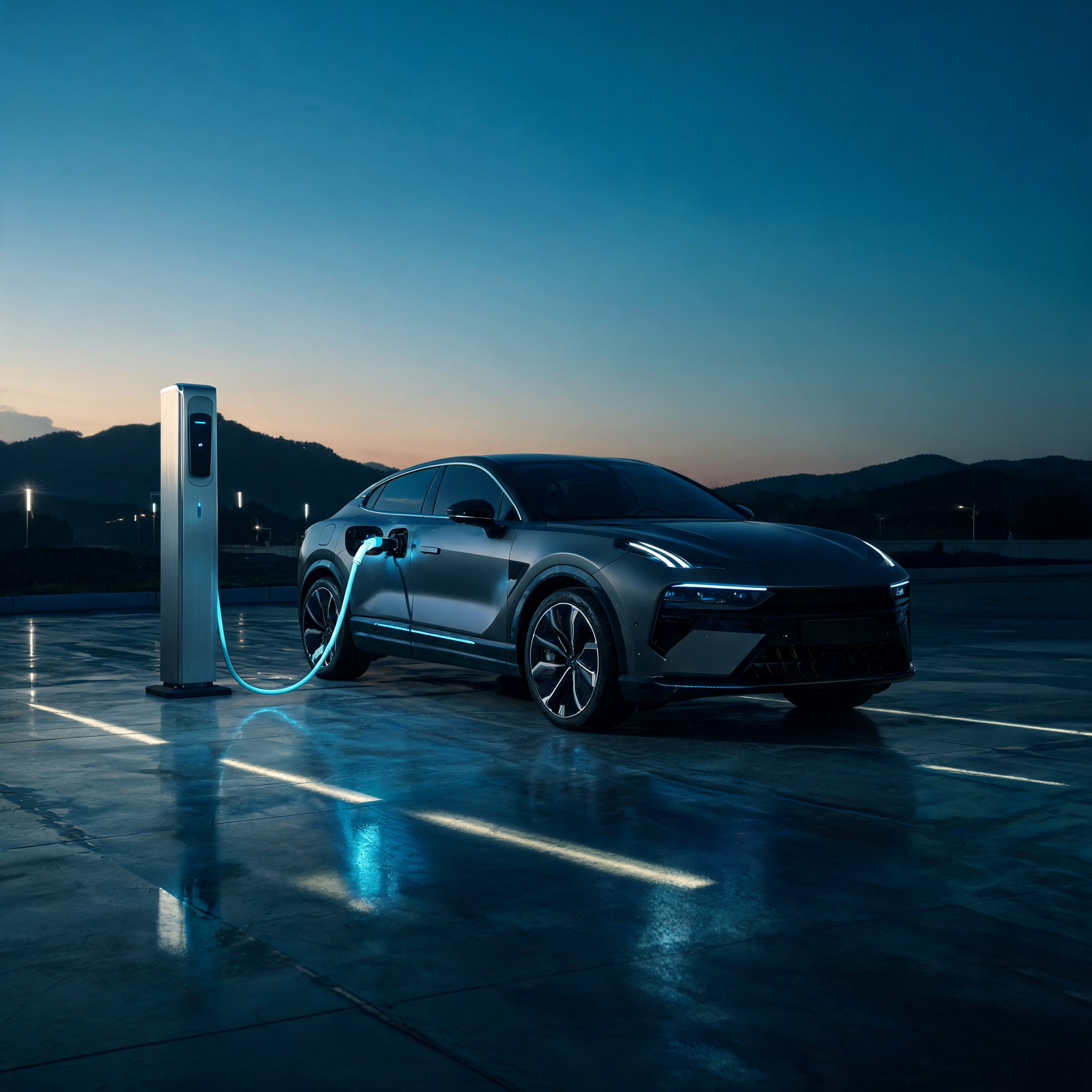
Porsche has extended its largest SUV family with an all-electric variant, the Cayenne Electric, and the S Coupé sits in the middle of that line-up. A first drive in the 2,560-kilogram coupé suggests the Premium Platform Electric (PPE) has been pushed further for this application — particularly at the fast charger, where the car delivered around 16 minutes from 10 to 80 per cent state of charge.
The Cayenne Electric had its world premiere in November 2025, and series production began in Bratislava at the start of February 2026. Porsche added the S in Coupé form in March 2026. The S produces up to 400 kW in normal driving and 490 kW with Launch Control, placing it between the base model at 300 kW (325 kW with Launch Control) and the Turbo at 630 kW (850 kW with Launch Control). With Launch Control, Porsche quotes 0 to 100 km/h in 3.8 seconds and a 250 km/h top speed for the S, against 4.8 seconds and 230 km/h for the base model and 2.5 seconds and 260 km/h for the Turbo.
Same platform, two redeveloped components
The Cayenne uses the same technical foundation as the Macan, the PPE, but Porsche redeveloped two central components for the larger model. The battery is more deeply integrated into the vehicle structure, and the S — like the Turbo — uses an oil-direct-cooled rear axle motor. Both axles carry permanently excited synchronous machines; the front motor is essentially derived from the Macan, while the rear unit is exclusive to the S and Turbo, with the base model using a water-cooled drive. Porsche obtains the Turbo's extra output not through a different motor but through a longer version of the same design, while the S gets the shorter one.
In the oil-direct-cooled machine, an electrically non-conductive oil draws heat directly from the copper windings. With conventional water-jacket cooling, heat must first reach the outer cooling jacket. Porsche says motor efficiency is up to 98 per cent and cites the more efficient cooling as one reason the S achieves a slightly higher range than the base model despite its greater power.
Chassis and driving behaviour
An adaptive air suspension with electronic damper control is standard. The test car also had Porsche Active Ride, an €8,324 option that Porsche says is being used in an SUV for the first time. Its active dampers are connected to a motor-pump unit on each axle and generate targeted forces at each wheel without mechanical stabilisers. In Comfort mode the system can overcompensate for roll and pitch to reduce the forces acting on occupants, and the Cayenne leans slightly into a curve rather than outwards; Sport and Sport Plus keep the body remarkably flat without becoming uncomfortably hard. Combined with precise steering and rear-axle steering, the S feels more agile than its size and weight suggest, although the mass cannot be fully masked: pushed too far, it understeers out of a curve, and the 22-inch wheels transmit short, sharp edges into the cabin. Rear-axle steering is a just-under-€1,700 option that shrinks the turning circle from 12.7 to 11.6 metres. Regenerative braking is integrated into the brake pedal, with the friction brake supplementing it as needed, and the transition is almost imperceptible. The ceramic brake system on the test car costs €10,100.
Battery and charging
The drivetrain draws on a battery with 113 kWh gross and around 108 kWh usable energy, arranged in six modules with 192 pouch cells — a different cell format from the Macan's prismatic cells. Porsche also changed the chemistry: a nickel-rich NMCA cathode (around 86 per cent nickel) and an anode with six per cent silicon raise energy density by about seven per cent over the previous NMC-811 chemistry, so the pack holds eight kilowatt-hours more than the Taycan's and is around 103 litres more compact. The silicon also improves fast-charging capability.
Full charging power is only available within a correct battery temperature window, and Porsche pre-conditions the battery automatically via the Charging Planner as soon as a charging stop is set as a navigation destination; there is no manual option. Two cooling plates per module heat or cool the cells from above and below, and Porsche says the pressure fans used require around 15 per cent less energy than conventional suction fans.
Porsche designs the charging curve to peak early: over 300 kW is available from around five per cent state of charge, with the theoretical maximum at around 55 per cent. In a recording at an EnBW HyperCharger starting at nine per cent, 333 kW was available at 12 per cent and around 360 kW from 13 per cent, rising to a peak of 386 kW at 44 per cent. The 390 kW from the data sheet was just short, which Porsche attributes to the charger rather than the car: it provides 390 kW only above 520 amps, while the HyperCharger delivers a maximum of 500. For 400 kW, Porsche specifies an even narrower operating point — over 850 volts, a battery temperature of 40 to 42 degrees and a state of charge of 45 to 48 per cent. After the first drop, the Cayenne continues at around 290 kW, holds about 270 kW between roughly 60 and 71 per cent, and still draws 183 kW at 80 per cent. The 10 to 80 per cent charge took around 16 minutes.
One drawback became apparent during the first fast-charging session: the cooling fans are noticeably loud during charging and briefly afterwards. Porsche's Quiet Charging mode, which can only be activated manually on the display after charging has started, reduces only the fan speed, lowering cooling performance and causing the battery to heat up faster; according to Porsche, the charging power has to be adjusted earlier only once the battery reaches its limit temperature. In a second session the car was noticeably quieter and the 10 to 80 per cent charge still took 16 minutes, with an almost identical 385 kW peak, although the high plateau ended earlier, at 42 per cent — 325 kW at 44 per cent against 386 kW in Normal mode. Porsche says Quiet Charging is primarily intended to reduce noise, and that a noticeable performance reduction occurs only at high starting battery and ambient temperatures; it cites a 10 to 80 per cent session at a starting battery temperature of 35 degrees and an ambient temperature of 45 degrees, where charging time can be extended by around one minute.
An optional 22 kW AC charger (€1,666) cuts the specified 0 to 100 per cent charging time from 11 to 5.8 hours; 11 kW is standard. Since the model-year change in September 2026, inductive charging has been regularly available to order: Porsche Wireless Charging with 11 kW and around 90 per cent efficiency costs €5,117.
Range, cabin and pricing
For the tested configuration, Porsche quotes a combined WLTP range of 616 kilometres, while the S Coupé range extends up to 669 kilometres — the highest among the Coupé variants. On mixed routes, consumption varied between around 20 and 27 kWh/100 km depending on speed; with around 108 kWh usable, 24 kWh/100 km equates theoretically to about 450 kilometres on a full charge, or around 315 kilometres using the 80 to 10 per cent window.
Inside, the infotainment is operated via a curved Flow Display, and the test car also had a passenger display and a head-up display with augmented reality, plus a separate control strip for volume and climate. Some functions are buried in submenus and the navigation map sometimes moves abruptly; the €934 surface heating for armrests and door panels was well received. The Coupé's flatter roofline slightly reduces practicality against the SUV: the luggage compartment holds 534 to 1,347 litres plus 90 litres in the frunk, with the Turbo offering 500 litres, and rear headroom is slightly tighter. All three electric Cayenne variants can tow up to 3 tonnes braked, rising to 3.5 tonnes with the €2,492 Off-Road Package.
The S Coupé starts at €130,300, but €69,440 of options brought the test car to €199,740; Active Ride, the ceramic brake system with black callipers and the lightweight sport package alone accounted for €34,589. Porsche's options list is generally extensive and costly, so the driving experience with active suspension and rear-axle steering cannot be transferred directly to a standard base S — though the large battery and high DC charging power are part of the basic technical offering. In competition, the S faces the BMW iX5, Mercedes EQS SUV and Audi SQ8 e-tron, with the Audi Q6 e-tron and Porsche's own Macan Electric a class below.