Meisam Abdi, a researcher at De Montfort University Leicester (DMU) in the UK, has won a 2026/27 Royal Academy of Engineering/Leverhulme Trust Research Fellowship to explore whether additive manufacturing can produce artificial muscles for soft robots.
Abdi was one of eight engineers in the UK to receive the award, which funds up to a year of research into materials and structures intended to let robots move, sense and respond more like living organisms.
Why softness matters
Abdi frames the work around safety in shared spaces. If people are to interact safely with robots in settings such as hospitals, he argues, the field needs to move away from completely rigid structures and consider how robots can be given some of the attributes found in living systems.
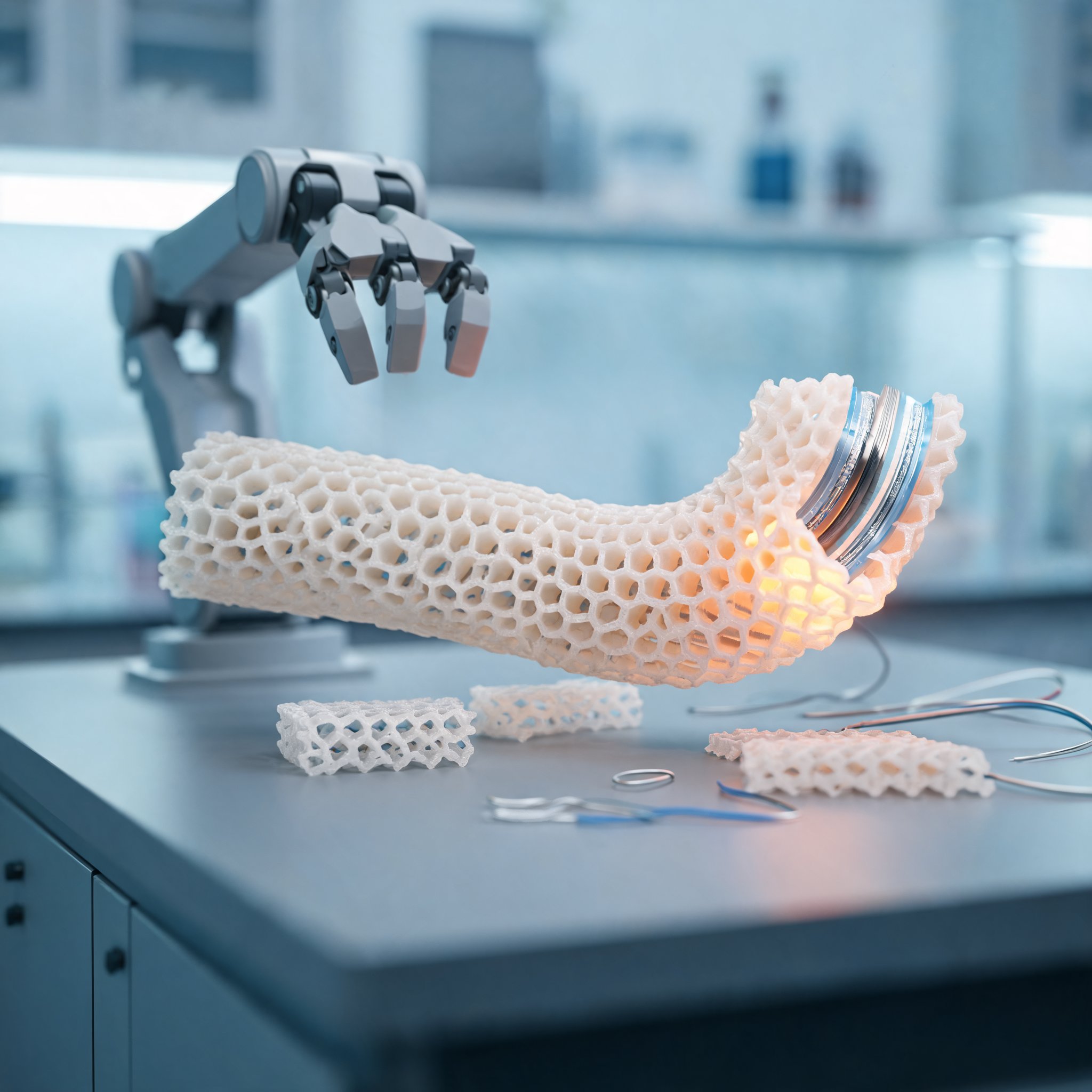
The project does not set out to replicate the physical structure of a human muscle. Instead, Abdi plans to use additive manufacturing to build architected structures whose geometry confers specific properties.
Piezoelectric building blocks
Combinations of piezoelectric, conductive and structural materials and architectures will be modelled with computer-aided engineering, 3D printed, and then tested in the laboratory for how they respond to electrical stimulation.
Piezoelectric materials are central because they can convert mechanical deformation into electrical energy and deform when an electric field is applied. DMU notes that existing high-performance piezoelectric materials are often stiff and brittle, and that some of the most widely used contain lead — factors that complicate the development of soft, flexible and more sustainable artificial muscles.
Abdi's approach pairs material composition with specially designed 3D printed cellular structures, aiming to reach the required properties while keeping the result soft and flexible.
Beyond mimicry
The longer-term aim is artificial muscles that can produce movement, sense their environment, and harvest small amounts of electrical energy from mechanical movement or vibration. Abdi describes biological systems as remarkable for combining movement, sensing and responses to external stimuli, and says the open question is whether an artificial structure can be designed and manufactured to reproduce some of those functions.
He is explicit that the goal is not to copy what already exists in nature. By changing materials and geometry, the work asks whether properties that do not currently exist naturally can be created.
"This is an ambitious project," Abdi said. Soft robotics already attracts significant research effort, he noted, but creating something that can begin to replicate the multiple functions of living muscle remains a major challenge. His stated ambition for the fellowship is to develop a prototype that demonstrates what is possible and provides a foundation for further research.