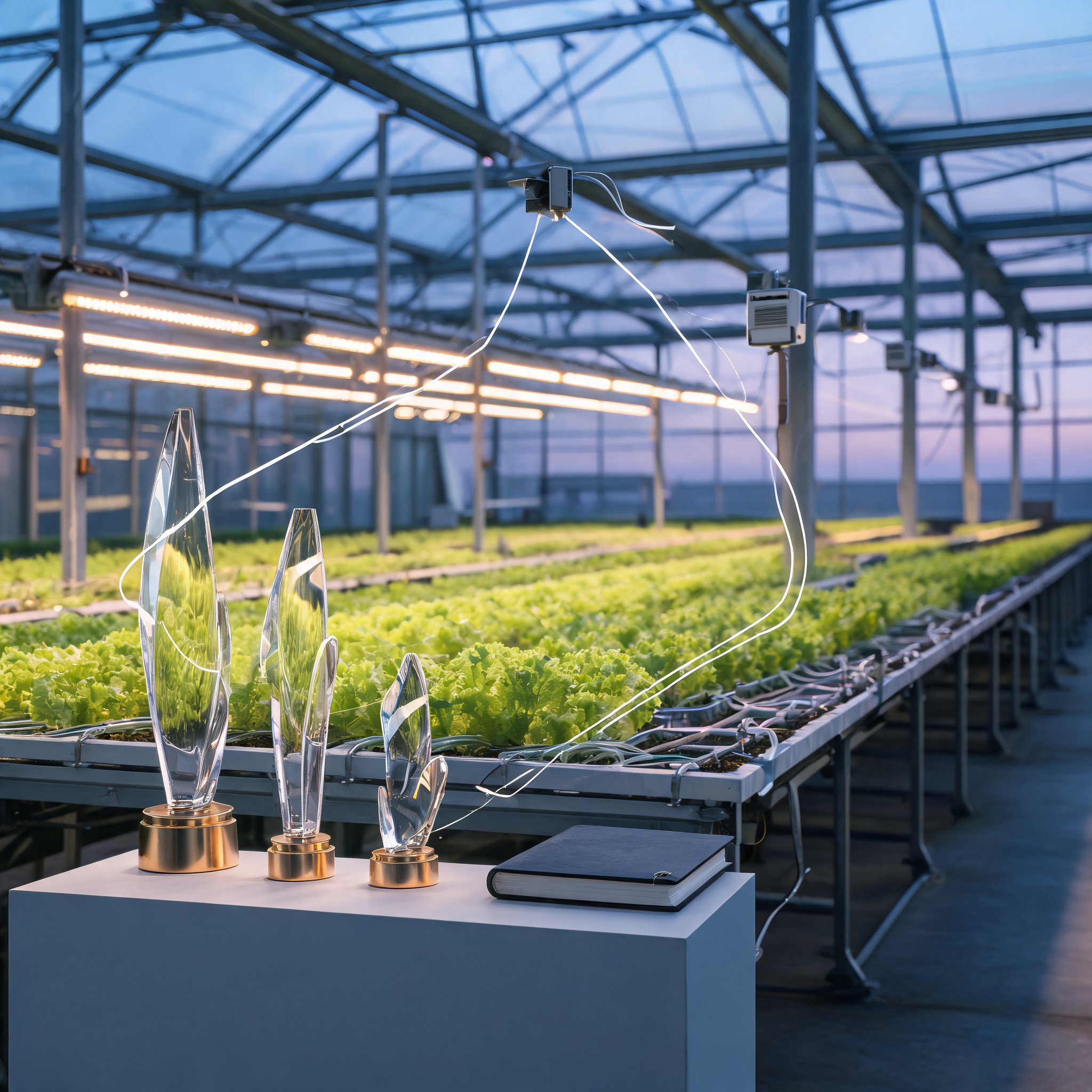
CEAg World, a sister brand of Greenhouse Grower focused on the greenhouse produce industry, announced the winners of the 2026 CEAg World Impact Awards during the opening ceremony of the CEAg World Conference and Expo in Charlotte, North Carolina. The awards, sponsored by ExxonMobil, recognize individuals who are driving progress in controlled environment agriculture (CEA) and advancing protected agriculture.
The winners span a greenhouse produce company, an automated lettuce operation and a university research center.
Kristin D. Zeit, group content lead for protected crops at Meister Media Worldwide, said it was an honor to give the three CEA luminaries the spotlight they deserve. She described their contributions to the business of growing produce under cover as remarkable and worth celebrating.
Leadership Award
The Leadership Award went to Paul Sellew, founder and CEO of Little Leaf Farms. When an earlier Cyclospora outbreak this year raised fresh questions about the safety of leafy greens, Sellew stepped forward to explain what greenhouse production can offer consumers. He used the moment to make a broader case that controlled growing environments, consistent production practices and clear communication can help build confidence in fresh produce.
Emerging Leader Award
Dominick DiMucci, director of cultivation at Haven Greens, received the Emerging Leader Award. At Haven Greens, automation moves baby-leaf lettuce through production with minimal hands-on handling, but DiMucci views the operation as more than a collection of machines. That systems-level thinking has helped shape his role in bringing Canada’s first fully automated greenhouse into commercial production. Since Haven Greens’ first harvest in March 2025, he has worked across cultivation, climate, irrigation and automation while helping coordinate the people and processes behind the crop.
Industry Advancement Award
Murat Kacira of the University of Arizona received the Industry Advancement Award. The university’s Controlled Environment Agriculture Center (CEAC) marks its 25th anniversary in 2026, and Kacira has played a significant part in its evolution and in the CEA industry’s evolution over time. He joined the university’s biosystems engineering faculty in 2007 and later succeeded founding director Gene Giacomelli as CEAC director. His research has helped move CEA closer to sensing what crops need and translating those signals into better management decisions.
The three honorees represent different parts of the CEA sector: a produce company leader addressing consumer confidence, a cultivation director working inside an automated greenhouse, and an academic researcher whose center is marking a quarter-century. Their recognition reflects the awards’ stated focus on people who are moving protected agriculture forward.